Spring Boot vs Node.js vs Django framework: Who Leads the Backend Race in 2025 Best Comparison?

Spring Boot vs Node.js vs Django framework
Spring Boot vs Node.js vs Django-Which backend framework dominates in 2025? This detailed comparison covers performance, scalability, job market, ecosystem, microservices, AI integration, cloud support, learning curve, and future trends to help developers and companies choose the best tech stack.
Introduction: The Framework Battle of 2025
The year 2025 marks a major evolution in backend technologies. With AI-driven applications, distributed microservices, edge computing, and cloud-native architectures becoming mainstream, choosing the right backend framework is more important than ever.
Among dozens of server-side technologies, Spring Boot, Node.js, and Django remain the top three widely-used backend frameworks globally. Each has a massive community, enterprise adoption, and proven reliability. But when innovation accelerates and business needs change rapidly, which framework stands out in 2025?
Let’s dive in and find out which backend framework truly leads in 2025.
What Are These Frameworks?
Spring Boot The Enterprise Powerhouse
Spring Boot is a Java-based framework known for building enterprise-grade, scalable, and secure microservices.
Backed by VMware and the Spring ecosystem, it is widely used in banking, telecom, insurance, fintech, and large enterprise systems.
Key Strengths:
-
Strong security (Spring Security)
-
Cloud-native architecture (Spring Cloud)
-
Mature ecosystem
-
Battle-tested for enterprise workloads
Node.js-The JavaScript Runtime Powering the Web
Node.js is not a framework; it’s a JavaScript runtime built on Chrome’s V8 engine, popular for real-time, fast, event-driven applications like chats, gaming, IoT, and streaming platforms.
Key Strengths:
-
Fast and lightweight
-
Huge NPM ecosystem
-
Ideal for real-time apps
-
Same language for frontend + backend
Django The Python Framework for Rapid Development
Django is a “batteries-included” Python framework emphasizing rapid development, readability, and secure design.
Key Strengths:
-
Extremely fast development
-
Excellent for ML/AI integration
-
Strong security features
-
Clear, clean, maintainable code
-
Huge Python community
Architecture Comparison
Spring Boot Architecture
Spring Boot uses a multi-layered architecture with:
-
Controller layer
-
Service layer
-
Repository layer
-
Domain layer
It’s ideal for clean, structured, enterprise-grade development.
Best For:
-
Microservices
-
Complex domain logic
-
Large-scale enterprise systems
Node.js Architecture
Node.js uses a single-threaded, event-driven, non-blocking I/O architecture.
This makes it incredibly efficient for high-concurrency workloads.
Best For:
-
Real-time communication
-
APIs with many parallel requests
-
Lightweight microservices
Django Architecture
Django follows an extended MTV (Model–Template–View) architecture.
Best For:
-
Rapid app development
-
Cleaner code and maintainability
-
ML/AI integrated applications
Performance Comparison (2025 Benchmarks)
Performance in 2025 is determined by:
-
Throughput
-
Latency
-
Concurrency
-
CPU usage
-
Memory footprint
Spring Boot Performance
Spring Boot is high performance, especially after improvements in newer Java versions (Java 21).
Pros:
-
Multi-threaded
-
Excellent under CPU-intensive load
-
Ideal for enterprise workloads
Cons:
-
Heavier memory usage
-
Slower start-up than Node.js
Node.js Performance
Node.js is blazing fast for I/O operations.
But for CPU-intensive tasks, it requires worker threads.
Pros:
-
Low latency
-
Non-blocking I/O
-
High concurrency
Cons:
-
Poor performance for CPU-heavy tasks
-
Call back hell (solved with async/await but still an issue at scale)
Django Performance
Django provides decent performance but is slower than Node.js and Spring Boot in raw throughput.
Pros:
-
Great for AI workloads
-
Efficient for CRUD apps
-
Fast development saves time
Cons:
-
Not ideal for real-time
-
Harder to scale horizontally
Comparison Table Performance (2025)
| Feature | Spring Boot | Node.js | Django |
|---|---|---|---|
| Start-up Time | Moderate | Fast | Moderate |
| CPU Intensive Tasks | Excellent | Weak | Moderate |
| Real-Time Apps | Good | Excellent | Weak |
| High Concurrency | Good | Excellent | Medium |
| Memory Usage | High | Low | Medium |
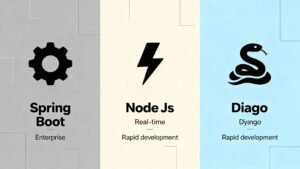
Scalability
Spring Boot Scalability
Spring Boot + Spring Cloud is the best option for enterprise microservices.
It supports:
-
Kubernetes
-
Docker
-
Service registry
-
Load balancing
-
Circuit breakers
Verdict:
Best scalability for enterprise and microservices.
Node.js Scalability
Node.js excels at horizontal scaling.
-
Run multiple event loops
-
Lightweight microservices
-
Auto-scaling with Kubernetes
Verdict:
Best for real-time and lightweight microservices.
Django Scalability
Django can scale, but requires more effort:
-
Multiple WSGI workers
-
Caching layers
-
Load balancers
-
Message brokers
Verdict:
Good, but not as easy as Spring Boot or Node.js.
Security Comparison
| Security Feature | Spring Boot | Node.js | Django |
|---|---|---|---|
| Built-in Security | Strong | Moderate | Strong |
| Protection from OWASP Risks | Excellent | Requires libraries | Excellent |
| Authentication Integration | Easy | Manual | Easy |
| Enterprise Security | Best | Good | Good |
Summary:
-
Spring Boot → best for enterprise security
-
Django → secure by default
-
Node.js → depends on packages
Development Speed & Learning Curve
Spring Boot
-
Steep learning curve (Java, Spring ecosystem)
-
Excellent documentation
-
Slower initial setup
Best For: Experienced developers
Node.js
-
Easy for beginners
-
Huge NPM modules
-
Fast prototyping
Best For: Beginners and JavaScript developers
Django
-
Fastest development
-
Minimal code needed
-
Pre-built admin panel
Best For: Start-ups, AI projects, MVPs
Ecosystem Strength (2025)
| Feature | Spring Boot | Node.js | Django |
|---|---|---|---|
| Libraries | Massive | Largest (NPM) | Strong |
| DevOps Integration | Excellent | Excellent | Good |
| Community Support | Strong | Massive | Strong |
| AI/ML Integration | Average | Good | Best |
Real-Time Capabilities
-
Node.js → Best (Web Sockets, Socket.IO)
-
Spring Boot → Good (STOMP, Webb Flux)
-
Django → Limited (needs Channels)
Cloud & DevOps Readiness
Spring Boot-Leader
-
Spring Cloud
-
Kubernetes native
-
Distributed tracing
-
Observability (Micrometre)
Node.js-Strong
-
Lightweight containers
-
Easy CI/CD
-
Great for serverless
Django-Moderate
-
Works well with Docker
-
Not cloud-native like Spring
Market Demand & Salary (2025)
Spring Boot (Java Developers)
High demand in:
-
Banking
-
Fintech
-
Insurance
-
Telecom
-
Government
Average Salary in India (2025):
₹12–30 LPA
Node.js Developers
High demand in:
-
Start-ups
-
Product companies
-
Real-time apps
-
SaaS
Average Salary:
₹8–22 LPA
Django Developers
High demand in:
-
AI/ML companies
-
Research apps
-
Start-ups
-
Ed-tech
Average Salary:
₹7–18 LPA
Use Case Comparison Which to Choose?
Choose Spring Boot When:
✔ Enterprise projects
✔ Microservices architecture
✔ High security is required
✔ Large teams
✔ Mission-critical systems
Choose Node.js When:
✔ Real-time apps (chat, gaming)
✔ IoT systems
✔ Start-ups
✔ Lightweight APIs
✔ Full-stack JS
Choose Django When:
✔ Rapid development
✔ AI/ML integration
✔ Scientific apps
✔ MVPs
✔ Research projects
2025 Future Trends
Spring Boot Future (Strong Growth)
-
Java 21 performance boosts
-
Cloud-native enterprise adoption
-
Spring AI for ML integration
-
Dominates enterprise segment
Node.js Future (Very Strong)
-
Growing npm ecosystem
-
Fastest adoption in startups
-
Serverless + edge computing
-
Web3, streaming, real-time apps
Django Future (Stable + AI Boost)
-
Python popularity increase
-
Easy integration with ML
-
Great for data-heavy systems
-
Becoming a favourite for AI-driven web apps
Final Verdict: Who Leads in 2025?
There is no single winner. Each framework leads its category.
Enterprise Winner: Spring Boot
Best choice for: banks, fintech, large systems, microservices.
Real-Time & Start-up Winner: Node.js
Best for chat apps, streaming, SaaS, IoT.
AI & Rapid Development Winner: Django
Great for AI projects, research apps, data apps, fast MVPs.
For more Info Visit geekforgeeks
Conclusion
In 2025, backend development has evolved dramatically. AI integration, distributed microservices, containers, cloud hosting, and real-time communication have changed how companies design systems. With this shift, Spring Boot, Node.js, and Django remain the most powerful frameworks each excelling in different areas.
Spring Boot continues to dominate enterprise software due to its unmatched reliability, security, and scalability. Backed by the Spring ecosystem, Spring Boot is the best option for complex, high-performance systems requiring microservices, cloud-native architecture, and long-term stability. Enterprises in fintech, telecom, healthcare, and government still prefer Spring Boot for mission-critical applications.
Node.js remains the top choice for startups and modern web applications. Its asynchronous, event-driven architecture makes it perfect for real-time systems such as chat apps, live streaming, gaming, and IoT. With NPM offering the largest package ecosystem in the world, Node.js supports rapid development and is particularly attractive for full-stack JavaScript teams.
Django, on the other hand, is the fastest way to build secure and scalable applications with minimal code. It remains unmatched for AI/ML integration due to Python’s dominance in data science. Django is also the smartest choice for start-ups that want to build a robust MVP quickly and scale later.
Final Verdict
The best framework is the one that suits your project’s requirements. Spring Boot leads in enterprise solutions, Node.js leads in start-ups and real-time apps, and Django leads in AI-based and rapid-development projects.
Related Updates
- Top 10 Programming Languages to Master in 2025 for High Salaries (Complete Guide)
- Generative AI in 2025: Revolutionizing Everyday Life Like Never Before
- Top 10 AI Tools to Make Money Online in 2025
- Generative AI in 2025: Revolutionizing Everyday Life Like Never Before