Tata Avinya EV: The Completely Different Electric Revolution Tata Motors Is Building in 2026 Best Guide
Discover why Tata Avinya EV is completely different from existing Tata cars, from its premium design and EV architecture to technology, comfort, sustainability, and its ambitious future.
Introduction
The Tata Avinya EV is not simply another electric car waiting to join Tata Motors’ growing EV portfolio. It represents a much broader idea of how a premium electric vehicle should look, feel, behave, and interact with its passengers. Tata originally presented AVINYA as a new paradigm of electric mobility rather than a conventional vehicle designed around an existing segment.
What makes this project particularly interesting is that Tata is attempting to move beyond the traditional formula of adding an electric powertrain to a familiar body style. The company’s original concept combined the characteristics of a premium hatchback, SUV, and MPV while focusing heavily on interior space, comfort, technology, sustainability, and passenger well-being.
Why Tata Avinya EV Is Completely Different
The Tata Avinya EV follows a philosophy that is fundamentally different from Tata’s earlier mainstream electric models. Instead of treating an EV primarily as an environmentally friendly version of an existing car, AVINYA was conceived around a dedicated electric architecture and a completely new vehicle experience.
The idea is important because dedicated EV platforms can provide designers with greater freedom to optimise cabin space, proportions, battery placement, aerodynamics, electronics, and software. Tata’s original AVINYA concept was built around its Gen 3 pure-EV architecture, signalling the company’s ambition to develop a new generation of electric mobility.
Kia India Sales 2026: Complete Growth Analysis, SUV Success, EV Expansion & Future Plans
A New Premium EV Identity for Tata
The Tata Avinya EV is also significant because AVINYA has evolved from being described simply as one concept vehicle into a broader premium electric vehicle family. Tata has previously indicated that AVINYA is intended to become a brand with multiple products rather than a single standalone model.
That distinction changes the entire story. Tata is not merely developing one expensive electric car; it is attempting to establish a premium EV identity capable of supporting different body styles and products. The AVINYA X concept presented in 2025 further demonstrated how this design language could be developed into a more premium SUV-oriented direction.
The Design: Neither SUV, Hatchback Nor MPV
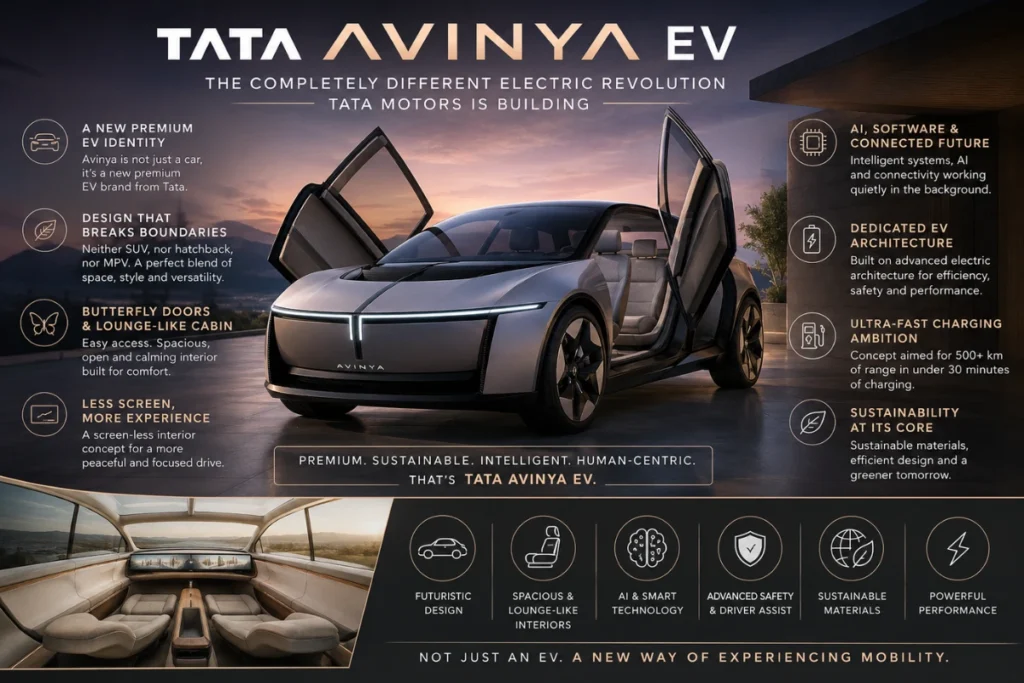
The Tata Avinya EV concept introduced an unusual body shape that deliberately avoided being locked into one traditional automotive category. Tata described the design as combining the essence of a premium hatchback, the versatility of an SUV, and the spaciousness and functionality of an MPV.
This approach is particularly relevant to electric vehicles because the absence of a conventional internal-combustion engine gives designers greater freedom to rethink proportions. Instead of designing the passenger compartment around an engine bay, designers can concentrate more heavily on cabin space, visibility, comfort, and the relationship between occupants and the vehicle.
Catamaran-Inspired Exterior Design
The Tata Avinya EV takes design inspiration from a catamaran, which helps explain its long, smooth, flowing proportions. Rather than relying heavily on sharp character lines and aggressive styling, the original concept emphasised a clean and aerodynamic appearance designed to communicate movement and efficiency.
The front and rear lighting signatures also introduced a new visual identity for Tata’s future electric vehicles. The concept’s horizon-inspired lighting treatment was intended to communicate openness and the possibilities associated with the company’s next-generation EV philosophy.
Butterfly Doors and a Lounge-Like Cabin
The Tata Avinya EV concept uses butterfly-style doors that create a dramatic entrance into the cabin. More importantly, these doors are part of a larger design philosophy focused on making the interior feel open, spacious, and welcoming rather than simply visually impressive.
Inside, Tata’s concept prioritises passenger experience over conventional dashboard design. The large glass area, open feeling, sustainable materials, lounge-style seating philosophy, and calming interior environment demonstrate that the company sees the vehicle as more than transportation—it is intended to become a comfortable personal space.
The Most Unusual Feature: Less Screen, More Experience
The Tata Avinya EV concept takes an unusual approach to automotive technology by questioning the assumption that a premium vehicle needs more and more screens. Tata deliberately explored a screen-less interior concept, arguing that reducing visual distractions could create a calmer environment for occupants.
This philosophy is almost the opposite of the current automotive trend where manufacturers compete over larger displays and increasingly complex digital dashboards. AVINYA instead imagines technology operating quietly in the background, allowing occupants to interact through voice and intuitive interfaces without constantly looking at screens.
Artificial Intelligence and Software-Defined Mobility
The Tata Avinya EV was conceived with software, artificial intelligence, connectivity, and advanced electronic systems playing an important role behind the scenes. Tata’s original concept specifically highlighted new-age technology and AI designed to support wellness, convenience, and a more seamless passenger experience.
This is an important change in automotive thinking. The future premium EV may increasingly be defined not only by horsepower or battery capacity but also by how intelligently it understands the driver and passengers. Software can influence infotainment, personalisation, connectivity, driver assistance, energy management, and potentially future over-the-air improvements.
The EV Architecture Is the Real Foundation
The Tata Avinya EV was originally presented on Tata’s Gen 3 pure-electric architecture, which was designed specifically around EV requirements. Tata described this architecture as flexible and focused on efficiency, connectivity, performance, safety, and advanced electronic systems.
However, the technology roadmap has evolved since the original concept was announced. In 2023, Tata and Jaguar Land Rover announced a plan involving JLR’s Electrified Modular Architecture for the premium Avinya series, but more recent reporting indicates that Tata has changed direction and is now pursuing a Chery-JLR/Chery-derived platform strategy for the production programme.
Why the Platform Change Matters
The Tata Avinya EV story is therefore not just about futuristic styling; it also demonstrates how difficult it can be to develop a premium EV platform from the ground up. Platform decisions influence development cost, vehicle pricing, engineering timelines, battery packaging, software architecture, manufacturing, and ultimately the competitiveness of the final product.
Recent reports indicate that Tata’s revised strategy is intended to accelerate development and improve cost competitiveness, with Tata expected to rework elements such as electronics and software for its own requirements. This could make the eventual production vehicles more commercially realistic than relying entirely on a costly premium architecture.
Range and Ultra-Fast Charging Ambitions
The Tata Avinya EV concept originally promised a major improvement in charging convenience. Tata’s concept documentation described an ultra-fast charging target capable of adding at least 500 kilometres of range in under 30 minutes, subject to the evolution of charging infrastructure and the final production implementation.
It is important to distinguish between a concept specification and a confirmed production specification. Battery capacity, real-world range, charging speed, battery chemistry, and charging curves for the final production vehicle should not be treated as confirmed until Tata officially announces them.
Top 5 EV Cars Launching in 2026 in India – Price, Features, Range & Launch Date
Premium Does Not Only Mean Luxury
The Tata Avinya EV is attempting to redefine what premium means in an Indian electric vehicle. Instead of concentrating exclusively on leather, screens, powerful motors, and expensive-looking materials, Tata’s concept places considerable emphasis on space, tranquillity, sustainable materials, natural light, technology, and passenger well-being.
The original concept even included features such as an aroma diffuser and sustainable interior materials. AVINYA X continued this wellness-oriented philosophy with lounge-style rear seating, hidden vents, fabric-wrapped elements, aroma features, and a less distracting dashboard environment.
Sustainability Is Part of the Design Philosophy
The Tata Avinya EV is designed around the idea that sustainability should extend beyond simply replacing petrol or diesel with electricity. Tata has highlighted sustainable materials, efficient electric architecture, lightweight construction, and energy-management strategies as important parts of its vision.
The AVINYA X concept takes this philosophy further through eco-conscious materials and a focus on efficiency. The broader objective is to create a vehicle where sustainability, premium design, technology, and comfort work together instead of being treated as separate features.
AVINYA X: The Next Evolution of the Original Concept
The Tata Avinya EV vision became even more interesting with the arrival of AVINYA X at the Bharat Mobility Expo 2025. Unlike the original concept’s unusual crossover-like silhouette, AVINYA X presents a more recognisable premium SUV direction while retaining the original philosophy of sustainability, technology, comfort, and well-being.
AVINYA X features elements such as matrix LED lighting, active aerodynamic features, aero wheels, a wide stance, and a long body intended to maximise cabin space. Its design suggests that Tata may use the AVINYA identity across different premium EV shapes rather than restricting it to one vehicle category.
How It Could Be Different From Tata’s Existing EVs
The Tata Avinya EV is positioned conceptually above Tata’s more mainstream electric products. Tata already has electric vehicles across several segments, including models such as the Tiago EV, Punch EV, Nexon EV, Curvv EV, and Harrier EV, while AVINYA represents a more premium and technology-focused direction.
The difference is therefore not simply expected battery size or price. AVINYA is intended to create a different ownership experience through dedicated electric proportions, premium materials, advanced software, greater cabin comfort, enhanced connectivity, sophisticated driver assistance, and a stronger emphasis on refinement.
What About Safety and Driver Assistance?
The Tata Avinya EV concept was designed with advanced driver assistance systems as part of its technology vision. Tata’s collaboration with JLR around the EMA platform had also highlighted advanced electronic architecture and the potential for Level 2+ autonomous driving capabilities, although these details should not automatically be assumed for the final production vehicle after the platform strategy changed.
For a premium EV competing internationally, safety will be an especially important area. Buyers will expect advanced active safety systems, strong crash protection, intelligent driver assistance, multiple sensors, robust electronic architecture, and high-quality braking and stability systems.
Expected Positioning and Future Models
The Tata Avinya EV is expected to sit above Tata’s current flagship electric offerings and compete in a more premium part of the Indian EV market. Current automotive reporting suggests that the first production model could arrive around 2027, while the AVINYA X direction is expected to play an important role in the production roadmap.
The larger ambition appears to be a family of premium electric vehicles rather than a single model. That could eventually allow Tata to offer different body styles, including SUVs and other premium formats, under the AVINYA identity while maintaining a consistent technology and design philosophy.
Why AVINYA Could Be Important for Tata Motors
The Tata Avinya EV could become strategically important because Tata Motors is trying to move from being primarily an accessible EV manufacturer toward becoming a stronger player in premium electric mobility. The company has already established significant recognition in India’s EV market, but the premium segment requires a different level of technology, refinement, software, design, and customer experience.
AVINYA therefore represents a much bigger challenge than launching another EV. Tata has to prove that an Indian automotive brand can create a premium electric experience capable of competing not only on price but also on design, technology, quality, performance, comfort, software, and global standards.
What Makes AVINYA Truly Different?
The Tata Avinya EV is different because its fundamental question is not “How can we make an existing car electric?” Instead, it asks “What should a car designed from the beginning around electric mobility become?” That philosophical difference influences its proportions, interior layout, technology strategy, materials, software, and passenger experience.
The production version will inevitably differ from the original concept because real-world vehicles must meet manufacturing, cost, safety, regulatory, reliability, and customer requirements. Nevertheless, the underlying AVINYA philosophy premium electric mobility combined with space, technology, sustainability, and well-being—could make the resulting vehicle one of Tata’s most significant launches.
Final Verdict: More Than Just Another Tata EV
The Tata Avinya EV represents Tata Motors’ attempt to enter a new chapter of electric mobility. From its unconventional design and dedicated-EV philosophy to its focus on software, AI, sustainability, wellness, premium interiors, and advanced charging, AVINYA is clearly intended to be much more than an electric version of an existing Tata car.
Its final success will depend on execution. If Tata can convert the ambitious concept into a production vehicle with competitive range, fast charging, premium quality, reliable software, strong safety, excellent performance, and sensible pricing, AVINYA could become a major turning point in Tata’s electric journey and a serious statement about India’s ability to build premium electric vehicles for the future.
Conclusion
The Tata Avinya EV is best understood as a vision for Tata’s next generation rather than simply another upcoming electric car. The journey from the original Gen 3 concept to the later AVINYA X and the evolving production-platform strategy shows that Tata is continuously adapting the programme to balance ambition with commercial reality.
If the production model successfully retains the original concept’s most important ideas spaciousness, simplicity, premium comfort, intelligent technology, sustainable materials, efficient electric performance, and a human-centric experience AVINYA could establish a completely new identity for Tata Motors in the premium EV market.
For more info visit tatamotors.com
Related Updates
- Maruti Suzuki Brezza Variant:2026 कौन सा वेरिएंट खरीदना सबसे बेहतर है? पूरी जानकारी !
- Tata Curvv Review 2026: Price, Mileage, Features, Pros & Cons – Should You Buy It?
- Nissan Tekton SUV Launch in India: Expected Price, Features, Specifications, Launch Date & Everything You Need to Know (2026) Best Reviews
- Tata Avinya EV interior revealed!2026 जानिए इसके लग्जरी इंटीरियर, AI फीचर्स, बैटरी, कीमत, लॉन्च डेट और संभावित मुकाबले की Best Guide
- Best Electric Cars for Indian Roads in 2026 – Top 5 EV Cars for Indian Families