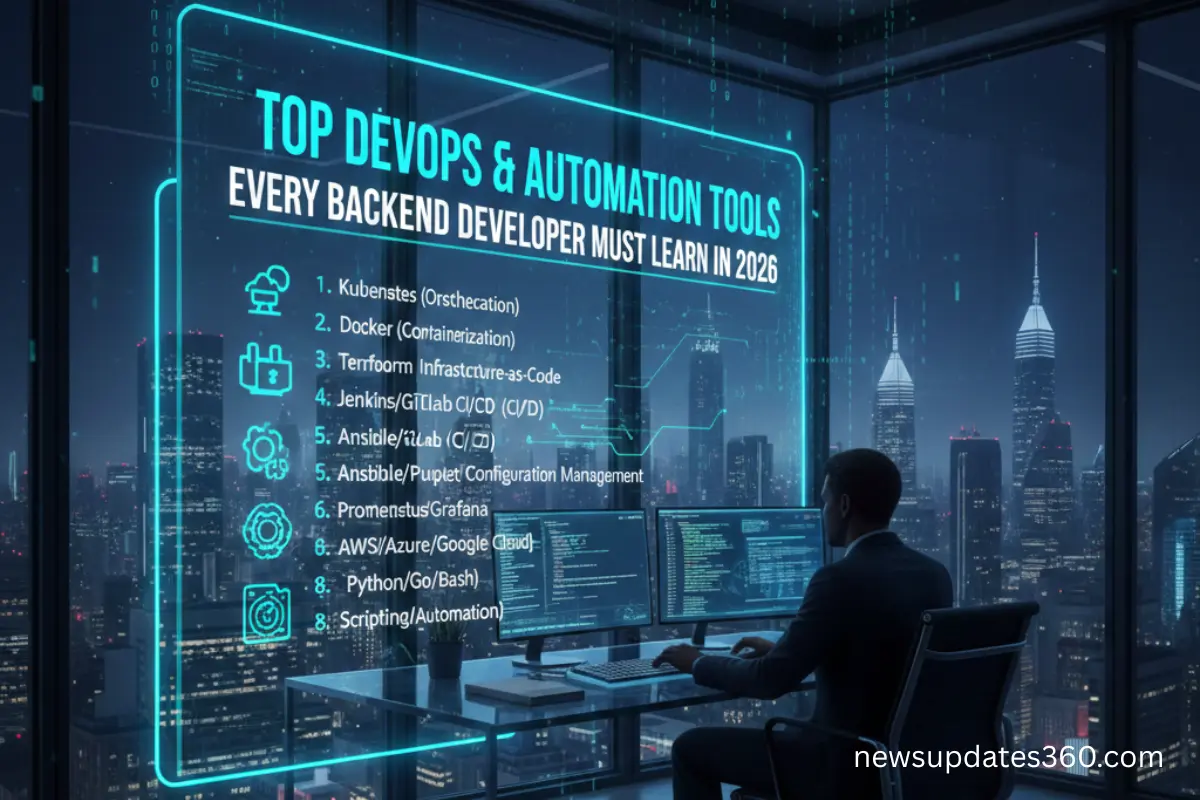
Top DevOps and Automation Tools Every Backend Developer Must Learn in 2026 best Guide
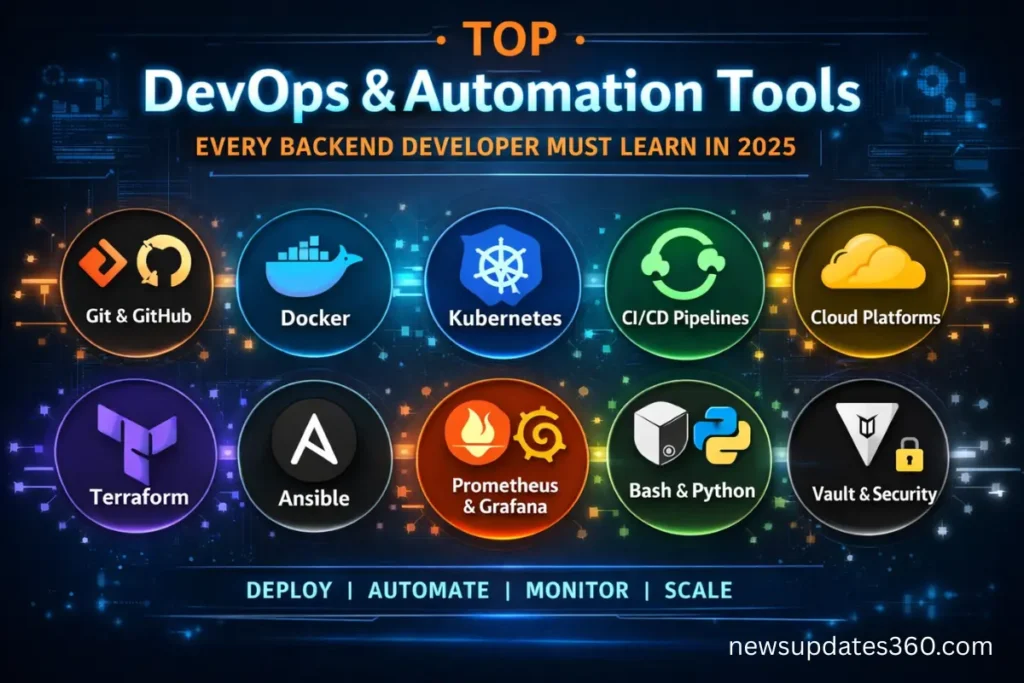
Discover the top DevOps and Automation tools every backend developer must learn in 2026. From Docker and Kubernetes to CI/CD, cloud, monitoring, and infrastructure automation a complete practical guide for modern developers.
Introduction
Backend development in 2026 is no longer limited to writing APIs, handling databases, or optimizing server-side logic. The role of a backend developer has evolved into something much bigger a developer who understands deployment, scalability, automation, and reliability.
Modern companies expect backend developers to:
-
Deploy applications confidently
-
Automate repetitive tasks
-
Handle production issues
-
Work closely with DevOps teams (or act as DevOps themselves)
This is where DevOps and automation tools come into play.
If you are a Java, Node.js, Python, or .NET backend developer and want to stay relevant in 2026, learning DevOps tools is no longer optional it is mandatory.
In this blog, we will explore the top DevOps and automation tools every backend developer must learn in 2026, explained in a practical, real-world, backend-focused way.
Why Backend Developers Must Learn DevOps in 2026
Before diving into tools, let’s understand why DevOps skills matter so much:
-
Faster deployment cycles
-
Reduced production bugs
-
Better scalability and performance
-
Stronger job profiles and higher salaries
-
Easier transition into Senior / Lead / Architect roles
In simple words:
If you can code + deploy + automate – you become extremely valuable.
1. Git & GitHub / GitLab – The Foundation of DevOps
Why it matters
Version control is the heart of DevOps. Every automation pipeline, CI/CD flow, and deployment starts with Git.
What backend developers must know
-
Git branching strategies (Git Flow, Trunk Based Development)
-
Pull Requests and Code Reviews
-
Merge conflicts resolution
-
Tags and releases
-
GitHub Actions or GitLab CI basics
Real-world usage
-
Triggering CI pipelines on code push
-
Maintaining production and development branches
-
Collaborating with multiple teams
Without Git mastery, DevOps automation is impossible.
2. Docker – The Most Important Tool for Backend Developers
Why Docker is mandatory in 2026
Docker solves one of the biggest backend problems:
“It works on my machine but not on production.”
Docker packages your application with:
-
Runtime
-
Dependencies
-
Configuration
What you must learn
-
Docker file creation
-
Multi-stage builds
-
Docker images and containers
-
Docker Compose
-
Container networking
Backend use case
-
Containerizing Spring Boot, Node.js, Django, or .NET apps
-
Running database + backend locally using Docker Compose
-
Standardizing deployments across environments
If you are a backend developer and don’t know Docker in 2026 you are already behind.
Top Cybersecurity Threats of 2025 and How to Stay Safe Online
3. Kubernetes – The King of Container Orchestration
Why Kubernetes is essential
Docker runs containers, but Kubernetes manages them at scale.
Almost every large organization uses Kubernetes for:
-
Auto-scaling
-
Load balancing
-
High availability
-
Zero downtime deployments
What backend developers should focus on
-
Pods, Services, Deployments
-
Config Maps and Secrets
-
Horizontal Pod Auto scaler
-
Rolling updates
-
Helm basics
Real-world example
-
Deploying microservices
-
Scaling backend APIs automatically
-
Managing multiple environments (dev, QA, prod)
You don’t need to be a Kubernetes admin – but you must understand how your backend app runs inside Kubernetes.
4. CI/CD Tools – Automation of Build and Deployment
What is CI/CD?
CI/CD automates:
-
Code build
-
Testing
-
Security checks
-
Deployment
Popular CI/CD tools in 2026
-
GitHub Actions
-
GitLab CI/CD
-
Jenkins
-
Azure DevOps Pipelines
Backend developer responsibilities
-
Writing pipeline YAML files
-
Automating unit and integration tests
-
Creating build artifacts (JAR, Docker image)
-
Deploying to cloud or Kubernetes
Why it matters
CI/CD:
-
Reduces human error
-
Speeds up releases
-
Improves code quality
A backend developer who can write CI/CD pipelines is highly preferred in interviews.
5. Cloud Platforms – AWS, Azure, and GCP
Why cloud knowledge is unavoidable
Almost all backend applications in 2026 are cloud-hosted.
Must-know cloud concepts
-
Virtual machines
-
Managed databases
-
Object storage
-
Load balancers
-
IAM (Identity and Access Management)
Popular cloud platforms
-
AWS (most popular)
-
Microsoft Azure
-
Google Cloud Platform
Backend developer focus
-
Deploying APIs on cloud
-
Connecting to managed databases
-
Using cloud storage
-
Understanding basic pricing models
You don’t need to memorize everything but you must be comfortable deploying your backend application to the cloud.
6. Infrastructure as Code (IaC) -Terraform
What is Infrastructure as Code?
IaC allows you to:
-
Create servers
-
Configure networks
-
Manage cloud resources
using code, not manual clicks.
Why Terraform is popular
-
Cloud-agnostic
-
Easy to learn
-
Version-controlled infrastructure
What backend developers should learn
-
Terraform basics
-
Providers (AWS, Azure)
-
State management
-
Creating EC2, databases, load balancers
Real-world benefit
-
Reproducible environments
-
Faster onboarding
-
Zero manual configuration errors
In 2025, production infrastructure is written in code – not created manually.
Game-Changing Multimodal Generative AI: Redefining Intelligent Workflows in 2025
7. Monitoring & Logging – Prometheus, Grafana, ELK
Why monitoring is critical
Writing code is only half the job.
Knowing how your backend behaves in production is equally important.
Popular tools
-
Prometheus – metrics collection
-
Grafana – dashboards & visualization
-
ELK Stack – logs management
Backend developer responsibilities
-
Exposing application metrics
-
Understanding CPU, memory, and latency
-
Analysing logs for errors
-
Debugging production issues
Why companies love this skill
Developers who understand monitoring:
-
Fix issues faster
-
Reduce downtime
-
Improve system reliability
8. Automation & Scripting – Bash and Python
Why scripting still matters
Even with advanced tools, scripting is unavoidable.
Common use cases
-
Deployment scripts
-
Server configuration
-
Log analysis
-
Backup automation
What to learn
-
Bash basics
-
Python for automation
-
Writing reusable scripts
-
Cron jobs
Backend advantage
Automation skills save time and prevent mistakes – making you more productive and reliable.
9. Configuration Management – Ansible
What is Ansible?
Ansible automates:
-
Server setup
-
Application configuration
-
Environment consistency
Why backend developers should care
-
No manual server configuration
-
Easy YAML-based syntax
-
Agentless architecture
Use cases
-
Installing backend dependencies
-
Configuring servers
-
Managing environment variables
10. Security & Secrets Management
Why security matters in DevOps
Backend developers handle:
-
API keys
-
Database credentials
-
Tokens and secrets
Tools to know
-
HashiCorp Vault
-
Cloud Secrets Manager
-
Kubernetes Secrets
Best practices
-
Never hardcode secrets
-
Rotate credentials
-
Use environment-based access
Security awareness is a big differentiator for senior backend developers.
DevOps Learning Roadmap for Backend Developers (2026)
If you’re confused where to start, follow this order:
-
Git & GitHub
-
Docker
-
CI/CD pipelines
-
Cloud basics
-
Kubernetes
-
Terraform
-
Monitoring & logging
-
Automation scripting
Top 10 Global Innovations future technologies 2030 that Will Change the World
Career Benefits of Learning DevOps Tools
Learning these tools helps you:
-
Crack backend + DevOps interviews
-
Move into Senior / Tech Lead roles
-
Handle production confidently
-
Get better salary packages
-
Become future-ready
In 2026, companies don’t want only coders they want engineers who can build, deploy, and scale systems.
Q&A
1. What are DevOps and Automation Tools and why are they important?
Answer:
DevOps and Automation Tools help organizations automate software development, testing, deployment, and infrastructure management. These tools reduce manual effort, improve collaboration between development and operations teams, and enable faster, more reliable software delivery. In modern backend development, automation ensures consistency, scalability, and stability in production environments.
2. How do DevOps and Automation Tools improve backend development workflows?
Answer:
DevOps and Automation Tools streamline backend workflows by automating builds, tests, deployments, and environment setup. They allow backend developers to focus on writing business logic while automation handles repetitive operational tasks. This leads to faster releases, fewer production issues, and better system performance.
3. Which DevOps and Automation Tools should backend developers learn first?
Answer:
Backend developers should start with DevOps and Automation Tools such as Git for version control, Docker for containerization, CI/CD tools for automated deployment, and basic cloud services. These tools form the foundation of modern backend systems and are widely used across start-ups and enterprises.
4. How do DevOps and Automation Tools support CI/CD pipelines?
Answer:
DevOps and Automation Tools enable Continuous Integration and Continuous Deployment by automatically building code, running tests, scanning for issues, and deploying applications. This automation ensures consistent releases, minimizes human errors, and allows teams to deliver updates frequently without downtime.
5. What is the role of DevOps and Automation Tools in cloud environments?
Answer:
DevOps and Automation Tools play a crucial role in cloud environments by managing infrastructure, scaling applications, monitoring performance, and handling deployments. Tools like Terraform, Kubernetes, and cloud-native CI/CD services help backend developers efficiently operate applications on AWS, Azure, or Google Cloud.
6. How do monitoring tools fit into DevOps practices?
Answer:
Monitoring tools help track application health, performance, and system resource usage in real time. They allow backend developers to detect issues early, analyse system behaviour, and improve reliability. Monitoring is a critical part of DevOps because it closes the feedback loop between development and production.
7. Why are automation skills essential for backend developers in 2026?
Answer:
Automation skills enable backend developers to handle deployments, scaling, and maintenance efficiently. As systems become more complex, developers who understand automation can manage infrastructure, reduce downtime, and respond quickly to failures. These skills make developers more valuable and future-ready.
Conclusion
The backend developer of 2026 is not just someone who writes APIs.
They are engineers who understand:
-
Automation
-
Deployment
-
Scalability
-
Reliability
By mastering the top DevOps and automation tools, you future-proof your career and stay ahead of the competition.
Start small, practice daily, and focus on real-world backend use cases.
DevOps is not a separate role anymore it is a core backend skill.
For more info visit spacelift
Related Updates
- Best Electric Cars in 2026: India & Global EVs Compared by Range, Price and Charging
- Generative AI in 2026: How Gemini, ChatGPT, and Grok Are Transforming the Future of Online Work
- How AI Will Impact Jobs in India by 2030: Reality vs Hype Complete Reviews
- How Vector Databases Power Modern AI Applications: The Backbone of Intelligent Systems in 2026